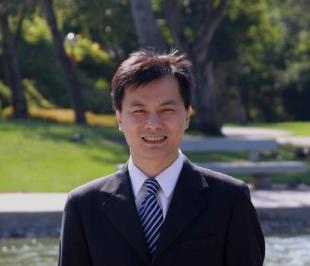
I am a professor of Department of Computer Science
at William & Mary,
and served as the graduate director of the department in
2010-2011. I got my PhD from Dartmouth College
under the supervision of Daniela Rus.
My research focuses
on edge computing, operating systems, distributed systems, cyber-physical systems, deep learning, security & privacy. It involves building and
simulating prototype systems, and conducting real experiments and
measurements. Check out our recent papers here.
I am currently working with
brilliant PhD students Lele Ma, Zeyi Tao, Qi Xia, and Jindi Wu. I am
interested in motivated students who would like to work on
operating systems, security and privacy, deep learning in
the context of edge computing systems.
Recently PhD graduated: Zhengrui Qin, Ed Novak, Nancy Carter,
Shanhe Yi, Yutao Tang, Zijiang Hao, Cheng Li.
I am the recipient of a
NSF Career Award and an IEEE Fellow.
I am the Founder and
Director of the Edge Computing
Laboratory. My publications include more than 100 international
journal articles, book chapters, conference/workshop papers,
and technical reports. Many of them are published in prestigious
conferences and journals (
ACM CCS’18, ICSE'16, Ubicomp'15, NSDI'13, Mobisys'13, Mobisys'12, Ubicomp'13, Pervasive'08, Mobicom'03, Mobicom'01, Mobicom'00, and Infocom'16, 15,
14, 13, 12, 11, 10, 09, 08, 06, 04). I am the general chair of
ACM/IEEE Symposium of Edge Computing (SEC'22)
and was the program co-chair of ACM/IEEE Symposium on Edge
Computing (SEC'19). I was the chair for many other conferences
including area chair for IEEE Infocom and track chair for IEEE
ICDCS. I was the steering committee chair of IEEE Transactions on Multi-Scale Computing Systems.
I also served as TPC member for numerous conferences and workshops
and was an Associate Editor of IEEE Transactions on Wireless
Communications. Currently I am on the editorial
board of IEEE Internet Computing and IEEE Transactions on Computers.
To add more information
:-), my Erdös
number is 3. My google scholar profile is here.
Classes
for this semester:
Edge Computing Group
Publications ( by year) Teaching
WM facts
Qun Li
Department of Computer Science
McGlothlin-Street Hall
College of William and Mary
Williamsburg, VA 23187-8795
Tel: 757-221-3478 (O)
Fax: 757-221-1717
E-mail: user: liqun domain: cs.wm.edu
Direction
to WM
|
News:
Our
undergraduate student Harry Gao has been selected as a
Finalist in the Computing Research Association's
Outstanding Undergraduate Researcher Award competition
for 2011. Congratulations!
PhD Alumni:
Haodong Wang, Cleveland State University,
Associate Professor.
Bo Sheng, UMASS Boston, Associate
Professor.
Chiu C. Tan, Temple University, Associate
Professor.
Fengyuan Xu, Nanjing University, Professor.
Hao Han, Nanjing University of Aeronautics and Astronautics, Professor.
Wei Wei, Beijing AOTO, company leader.
Yifan
Zhang, SUNY Binghamton, Assistant Professor.
Zhengrui Qin, Northwest Missouri State University, Assistant Professor.
Ed Novak, Franklin and Marshall College,
Assistant Professor.
Shanhe Yi, VMware
Yutao Tang, Walmart Technology
Zijiang Hao, LinkedIn
Cheng Li, Google
|
|
|